
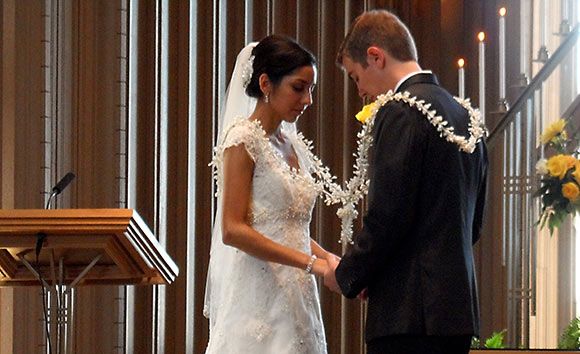
The wedding lasso is one of the most beautiful moments in a Catholic wedding. After the couple exchanges vows, a large rosary or cord is placed around both of them in a figure eight, joining them together as they kneel. It is a Hispanic and Filipino tradition with deep roots, and more and more couples of every background are asking to include it in their own ceremonies.
If you have been to a Mexican or Filipino wedding, you have probably seen it. If you are planning your own wedding and want to understand where the custom comes from, what it means, and how to choose a lasso rosary, here is a plain guide.
What is a wedding lasso?
A wedding lasso, called el lazo in Spanish, is a large loop placed around the shoulders of the bride and groom during the wedding ceremony. It can be an oversized rosary, a decorative cord, or a double loop of flowers, but the rosary lasso is the most common. After the couple has exchanged their vows, their sponsors place the lasso over the groom's shoulders first, then the bride's, forming a figure eight that links the two of them together.
The couple wears the lasso for the rest of the ceremony. At the end, the priest or the sponsors who placed it lift it off, and in many families the couple keeps it as a lifelong keepsake.
What does the wedding lasso symbolize?
The lasso is a visible sign of two lives being joined into one. A few layers of meaning come together in that single moment:
- Unity. The couple is now bound together, sharing one life, one home, and the work of raising a family. It carries the same idea as the unity candle many Catholic couples use.
- Forever. The lasso is laid in a figure eight, which is the mathematical symbol for infinity. No beginning, no end.
- New beginnings. In Scripture the number eight is tied to new life and fresh starts, which fits the beginning of a marriage.
- God at the center. When the lasso is a rosary, it shows that the marriage is bound together not only by the couple's love but by God and the prayers of the Blessed Mother.
Who places the lasso, and when?
The lasso is usually placed by the wedding sponsors, called los padrinos and las madrinas. These are often a married couple the bride and groom look up to, sometimes godparents or close relatives, who agree to pray for and support the marriage. Choosing your lasso sponsors is a meaningful way to honor people who have shaped your faith.
In the order of the Mass, the lasso goes on after the exchange of vows and rings, and the priest offers a prayer over the couple. A common form is close to this: "Let the binding of this lasso be an inspiration to you both. The holiness needed to keep your new family strong is found in mutual sacrifice and love." The couple wears it through the remainder of the ceremony.
Where does the tradition come from?
The custom is centuries old and is strongest in Mexican, Filipino, and Spanish Catholic communities, where it has been handed down for generations. Both cultures share the same root: Spanish Catholic missionaries carried the practice to the Americas and the Philippines, and each place made it their own. That is why you will sometimes see a single cord, sometimes a double rosary, and sometimes a lasso of white flowers.
What does a lasso rosary look like?
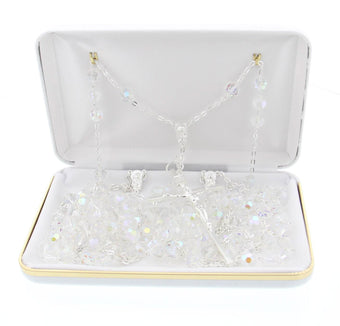
A rosary lasso is made by joining two rosaries together, connected in the center by a single crucifix, so it is long enough to loop around both people. Ours run about 53 to 54 inches, large enough to rest comfortably over the couple's shoulders. They come in different materials and finishes so you can match the look to your wedding, from formal pearl to shimmering crystal.
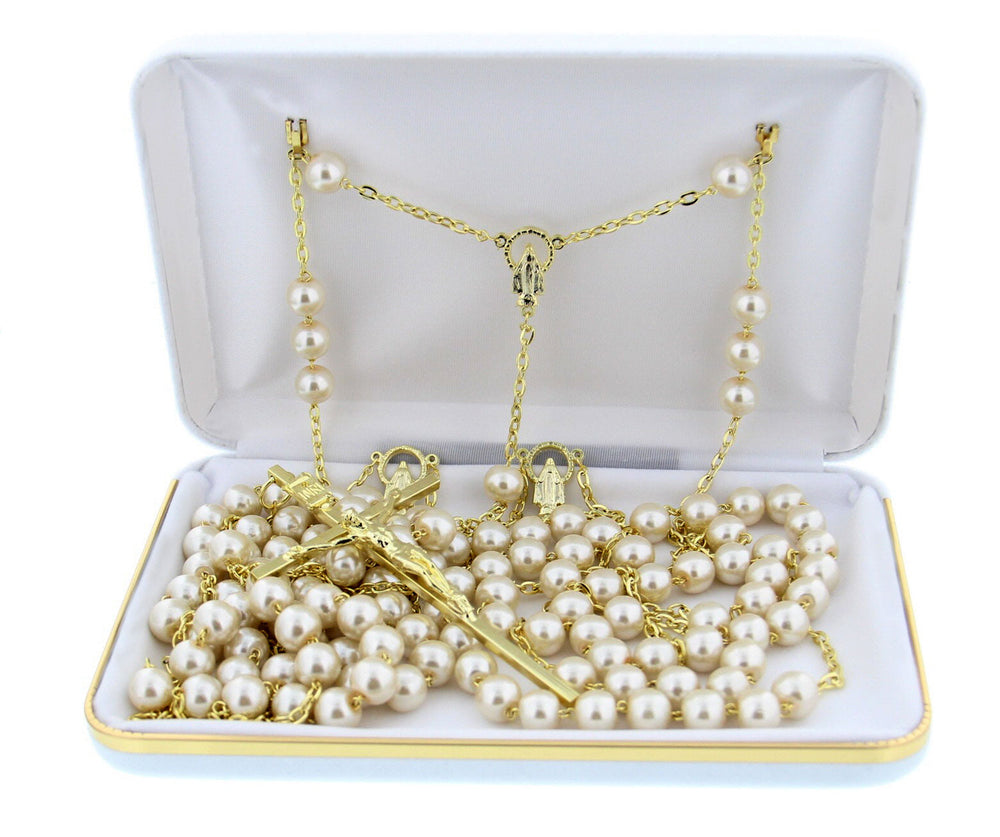
How to choose a wedding lasso rosary
A few simple things to think about as you pick one:
- Match your metals. If your wedding leans warm, gold tone accents look right. If it leans classic and cool, choose silver tone.
- Pearl or crystal. Pearl beads give a soft, formal, traditional look. Crystal beads catch the light and photograph beautifully.
- Think about the keepsake. Many couples frame the lasso or hang it in their home afterward, so pick one you would be happy to see for years. A keepsake box is worth adding if you plan to save it.
- Ask your parish. Some churches have their own customs for the lasso, so it is worth checking with your priest or deacon as you plan.
Frequently asked questions
What is the wedding lasso?
A large loop, often an oversized rosary, placed around the bride and groom during the ceremony as a sign that their two lives are now joined as one.
What does the wedding lasso symbolize?
Unity between the couple, the infinity of the figure eight shape, and, when a rosary is used, the marriage being bound together by God.
Who puts the lasso on the couple?
The wedding sponsors, the padrinos and madrinas, usually place it after the vows, starting with the groom and then the bride.
What cultures use the wedding lasso?
It is a long-standing tradition in Mexican, Filipino, and Spanish Catholic communities, and couples of other backgrounds are increasingly adopting it.
Do you keep the lasso after the wedding?
Yes. Many couples keep the lasso as a lasting keepsake, and some frame or display it in their home.
Shop wedding lasso rosaries
|
|
|


