

Devotion to Our Lady of Sorrows is one of the oldest and most tender parts of Catholic prayer life. It asks us to stay close to Mary through the seven great griefs she carried as the Mother of Jesus, from the day Simeon warned her that a sword would pierce her heart to the evening she watched her Son laid in the tomb. The Church keeps her memorial every year on September 15, the day after the Exaltation of the Holy Cross.
If you have ever stood beside someone you love while they suffered and felt powerless to change it, you already understand something of what Mary lived. That is why this devotion has comforted grieving people for centuries. Mary does not stand at a distance from our pain. She has been through it, and she walks with us.
What is the devotion to Our Lady of Sorrows?
The devotion honors the Blessed Virgin Mary under her title Mater Dolorosa, which means "Mother of Sorrows." It centers on the Seven Sorrows of Mary, seven moments in her life when she shared most deeply in the suffering of her Son. You will often see her pictured with one or seven swords through her heart. That image comes straight from Scripture, when the old man Simeon told her at the Presentation, "a sword will pierce your own soul too" (Luke 2:35).
Honoring Mary's sorrows is not about dwelling on sadness. It is about learning to love the way she loved: faithfully, all the way to the cross, without running away when things got hard.
The Seven Sorrows of Mary
These are the seven events the devotion asks us to pray through, in order, each one drawn from the Gospels:
- The Prophecy of Simeon — Simeon foretells that Mary's heart will be pierced (Luke 2:22–35).
- The Flight into Egypt — Mary and Joseph flee by night to protect the Child from Herod (Matthew 2:13–14).
- The Loss of the Child Jesus in the Temple — Three days of searching before Mary and Joseph find Him (Luke 2:43–45).
- Mary Meets Jesus on the Way to Calvary — She meets her Son as He carries the cross toward His death.
- Jesus Dies on the Cross — Mary stands at the foot of the cross as He dies (John 19:25).
- Mary Receives the Body of Jesus — She holds her Son taken down from the cross, the moment captured in the Pietà.
- Jesus Is Laid in the Tomb — Mary sees the stone rolled across the tomb and waits in hope.
When is the Feast of Our Lady of Sorrows?
The feast falls on September 15, right after the Church celebrates the Exaltation of the Holy Cross on September 14. The placement is no accident. Once we have honored the cross of Christ, we turn to the mother who stood beneath it. For much of the Church's history there was also a second commemoration on the Friday before Good Friday, sometimes called the Friday of Sorrows, and many families still keep that Lenten custom at home.
How to pray the Seven Sorrows Chaplet
The most common way to practice this devotion is the Chaplet of the Seven Sorrows, also called the Servite Rosary. It was spread by the Servite Order (the Order of Servants of Mary), founded in the thirteenth century. The chaplet uses seven groups of seven beads. Here is the simple pattern:
- Begin by making the Sign of the Cross and asking Mary to help you enter into her sorrows.
- For each of the seven sorrows, read or recall the event, then pray one Our Father and seven Hail Marys while you reflect on it.
- Move through all seven sorrows the same way, in order.
- Close with three Hail Marys in honor of Mary's tears, and a short prayer asking for her intercession.
You do not need a special chaplet to start. An ordinary rosary or even your fingers will do. What matters is the meditation, not the beads.
The Stabat Mater
Alongside the chaplet, the Church has long prayed the Stabat Mater, a thirteenth-century hymn traditionally attributed to Jacopone da Todi. Its opening line, "At the cross her station keeping, stood the mournful Mother weeping," puts us right beside Mary at Calvary. Many parishes sing it during the Stations of the Cross in Lent, so you may already know the melody even if you never knew its name.
The promises of the devotion
According to a long-standing tradition, Our Lady made a set of promises to St. Bridget of Sweden for those who faithfully honor her sorrows, including the grace of her comfort in life and her presence at the hour of death. These promises are part of Catholic piety rather than defined doctrine, but they point to something the saints have always trusted: Mary is quick to help the people who keep her company in her grief.
Simple ways to live this devotion
You do not have to overhaul your day to grow closer to Our Lady of Sorrows. A few small habits go a long way:
- Pray one sorrow each day of the week, so you cover all seven by Sunday.
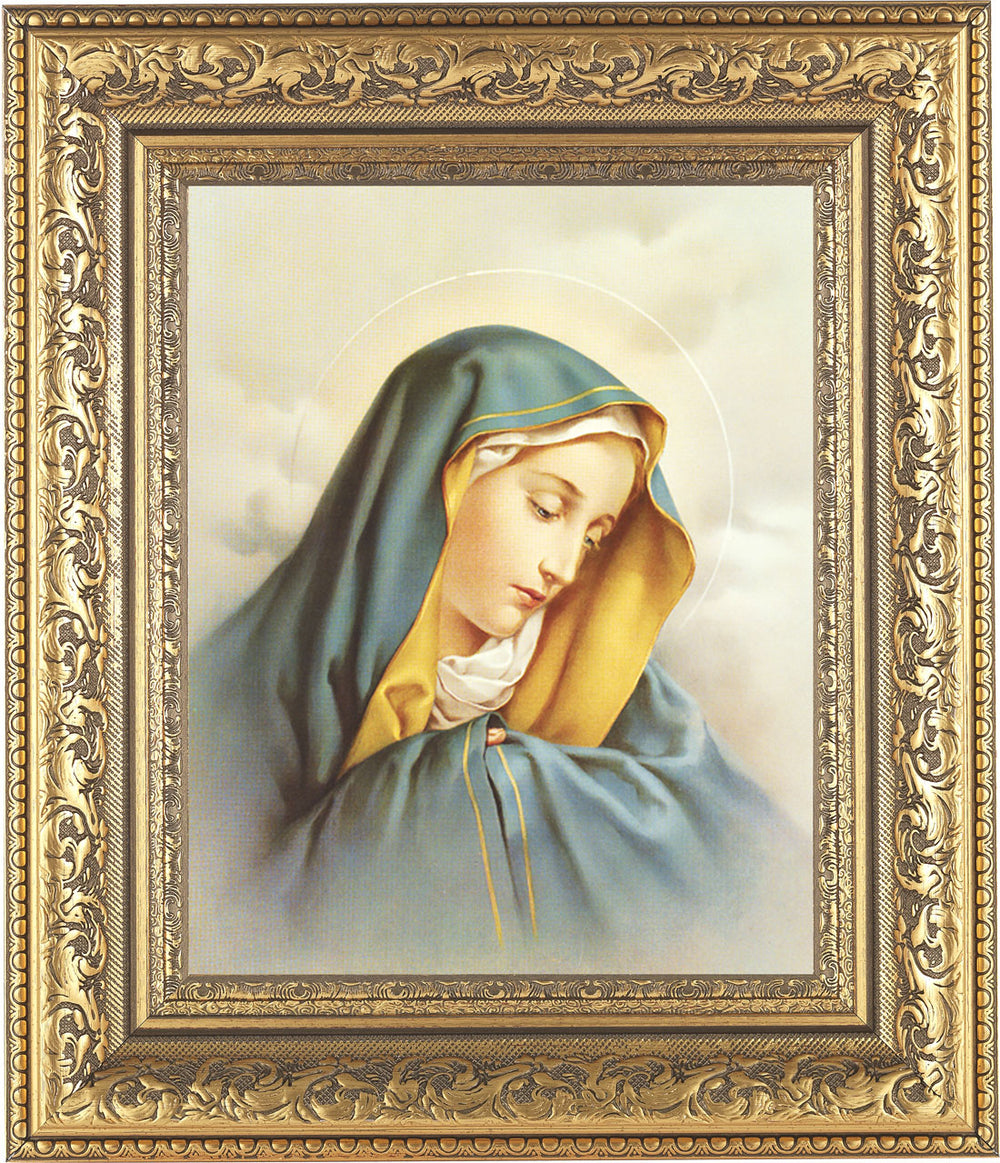
- Keep an image or statue of the Sorrowful Mother where you pray, so the devotion has a home in your house.
- Offer your own hard days to her, the way you would tell a mother what is weighing on you.
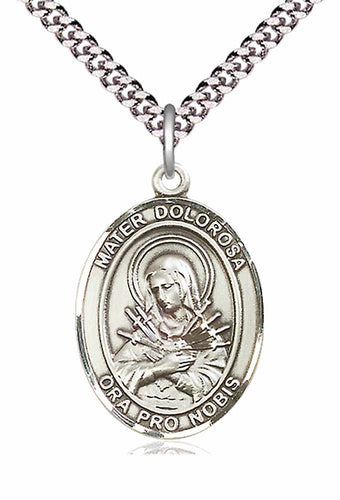
- Wear a Mater Dolorosa medal as a quiet reminder to ask for her prayers.
Frequently asked questions
When is the Feast of Our Lady of Sorrows?
September 15, the day after the Exaltation of the Holy Cross.
Why is Mary shown with a sword through her heart?
It comes from Simeon's prophecy at the Presentation, when he told Mary a sword would pierce her soul (Luke 2:35). Seven swords represent the Seven Sorrows.
Is Our Lady of Sorrows the same as the Mater Dolorosa?
Yes. Mater Dolorosa, the Sorrowful Mother, and Our Lady of Sorrows are all titles for the same devotion to Mary in her suffering.
How do you pray the Seven Sorrows Chaplet?
For each of the seven sorrows, pray one Our Father and seven Hail Marys while reflecting on that event, then close with three Hail Marys in honor of Mary's tears.
What is Our Lady of Sorrows the patron of?
She is the patroness of Slovakia and is invoked especially by those who are grieving, caregiving, or carrying a heavy cross.
Suggestions for you
|
|
|