
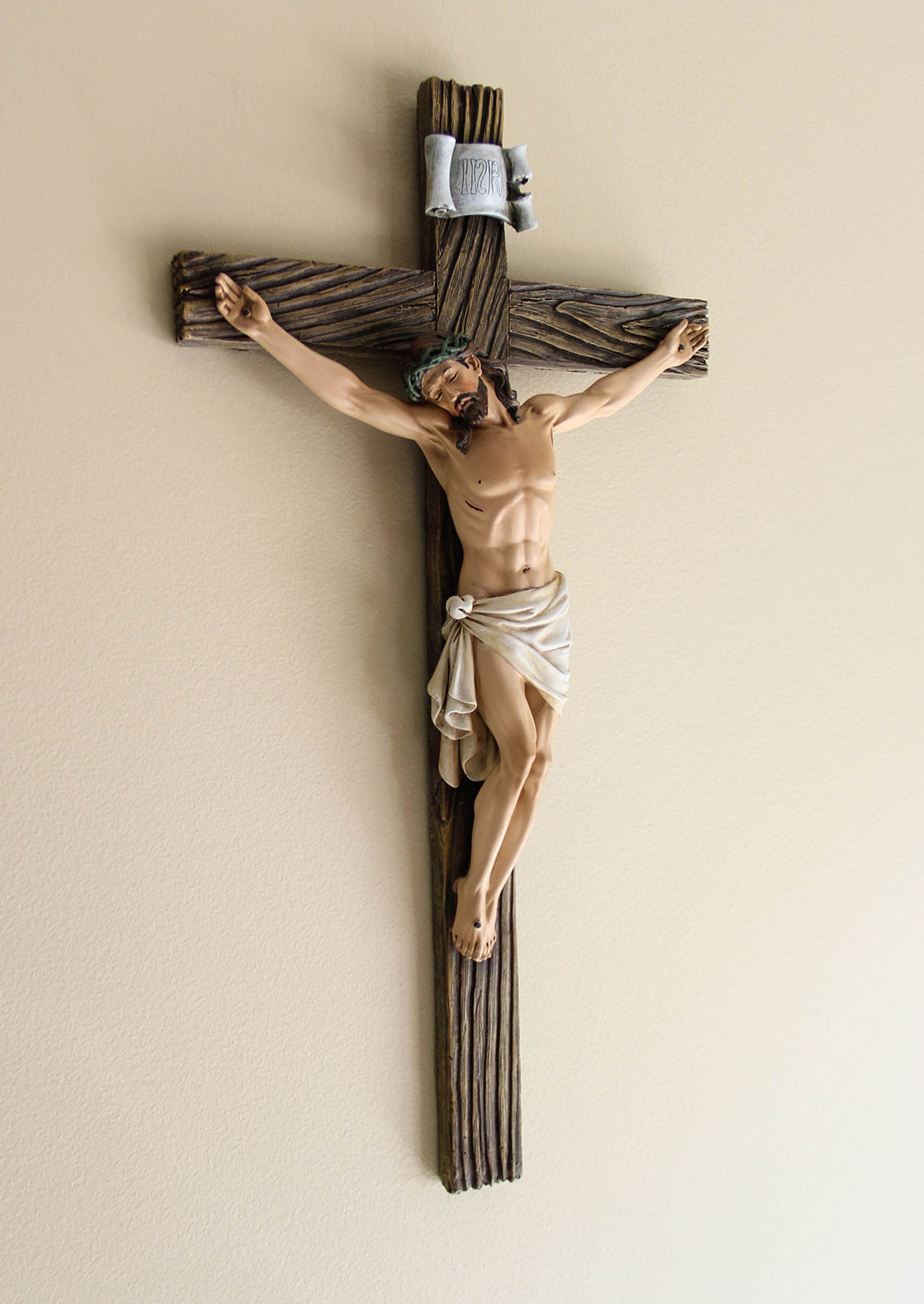
The crucifix is one of the most recognizable images in the world, and for Catholics it is the heart of the faith made visible: Christ, on the cross, giving his life for us. Displaying one in your home is an old and meaningful practice. It keeps that love in front of you, day after day. Here is why it matters, what makes a crucifix different from a plain cross, what the letters at the top mean, and how to choose and display one.
Why display a crucifix in your home?
A crucifix is a powerful image. It shows Christ in his suffering, and that can be hard to look at. But it is also a triumphant image, because that suffering was for us. It reminds us that our sins are forgiven and that death is not the end.
How often do you mean to stop and pray, only to have the day slip away? For most of us, more often than we would like. A crucifix on the wall is a quiet interruption. Passing it is like splashing cold water on your face, a small nudge to stop, pray, and remember what Christ did for you.
It is also a companion in hard times. Everyone hits rough patches, and in the middle of them it is easy to feel that no one understands. But Christ does. Who would know suffering better than he does? A crucifix in your home is a steadying reminder that you are not alone in yours, and that, like him, if you hold on through the hard stretch, you will come through it.
What is the difference between a cross and a crucifix?
People use the words interchangeably, but they are not quite the same. A cross is the two bare beams. A crucifix is a cross that bears the corpus, the figure of Christ crucified upon it. That is the key difference, and it is why the crucifix is so closely associated with Catholic and Orthodox Christians: it keeps our eyes not just on the cross, but on the One who hung there for us.
A short history of the crucifix
The crucifix took its familiar form slowly. Early Christian crucifixes, from the time of Constantine in the fourth century onward, usually did not show Jesus suffering at all. For several centuries he was depicted alive, eyes open and arms outstretched, triumphant over sin and death. Many of these Romanesque crucifixes even showed Christ wearing a royal crown. Later Gothic versions replaced the royal crown with the crown of thorns, and it was only around the ninth century that artists began to show the realistic suffering of Christ's death. Both images are true: the crucifix holds together his agony and his victory.
What does INRI mean?
At the top of many crucifixes are the letters I.N.R.I. They stand for the Latin Iesus Nazarenus Rex Iudaeorum, meaning "Jesus of Nazareth, King of the Jews." This was the titulus, the charge that Pontius Pilate ordered fixed above Jesus' head on the cross, written in Hebrew, Latin, and Greek (John 19:19-20). Pilate meant it as a mockery, but it states the plain truth: Christ is our King. The relic of that inscription is venerated to this day at the Basilica of the Holy Cross in Jerusalem, in Rome.
Where to display your crucifix
Where you hang it is up to you. Many families place a crucifix where it can be seen the moment someone walks in the door, as a quiet witness of their faith. Others keep one in the main living area, or set it at the center of a prayer corner where they can sit in quiet reflection. Crucifixes come in many sizes, materials, and finishes, so you can find one that fits your home and your taste. Many people also ask a priest to bless the crucifix, which makes it a sacramental, a sacred reminder of the faith.
Prayer before the crucifix
This traditional prayer was written to be prayed before a crucifix, and you can pray it at home:
Behold, O kind and most sweet Jesus, I cast myself upon my knees in Your sight, and with the most fervent desire of my soul I pray and beseech You that You would impress upon my heart lively sentiments of faith, hope, and charity, with true repentance for my sins and a firm purpose of amendment, while with deep affection and grief of soul I ponder within myself and contemplate Your five most precious wounds, having before my eyes the words which David spoke in prophecy: "They have pierced my hands and feet; they have numbered all my bones."
Frequently asked questions
What does INRI mean on a crucifix?
It stands for the Latin Iesus Nazarenus Rex Iudaeorum, "Jesus of Nazareth, King of the Jews," the sign Pontius Pilate placed above Jesus on the cross.
What is the difference between a cross and a crucifix?
A cross is the bare beams alone. A crucifix bears the figure of Christ, the corpus, upon the cross.
Where should you hang a crucifix in your home?
Wherever it will be seen and honored, often near the entryway, in the main living area, or at the center of a prayer corner.
Should a crucifix be blessed?
It doesn't have to be, but having a priest bless it makes it a sacramental. Many families have a new crucifix blessed before hanging it.
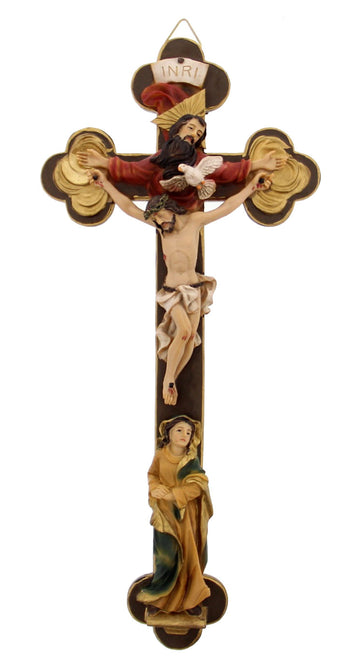
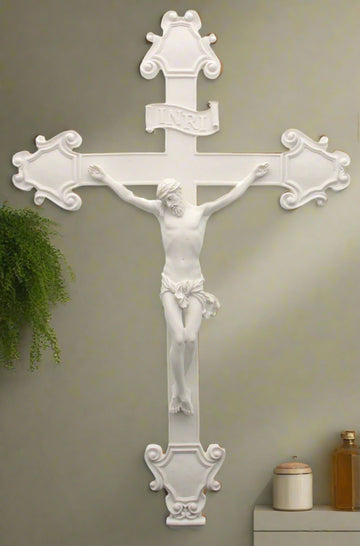
Crucifixes for your home
|
|
|
Shop all crosses & crucifixes »
Related articles
How to Create a Catholic Prayer Corner at Home


